
The State Archives moved into a new building next to the Vardar River 13 years ago, as part of the “Skopje 2014” project. In this facility, the institution faces poor conditions in fulfilling its obligation to preserve important state documents, such as the oldest records dating back to the 12th century and the extensive collection of the Bitola Kadilak, which contains thousands of documents on social and economic conditions.
Two years ago, the Investigative Reporting Lab (IRL) reported that almost every time it rains, поплавува the premises are flooded and water penetrates not only the employees’ offices, but also the archive depot where the documents are stored.
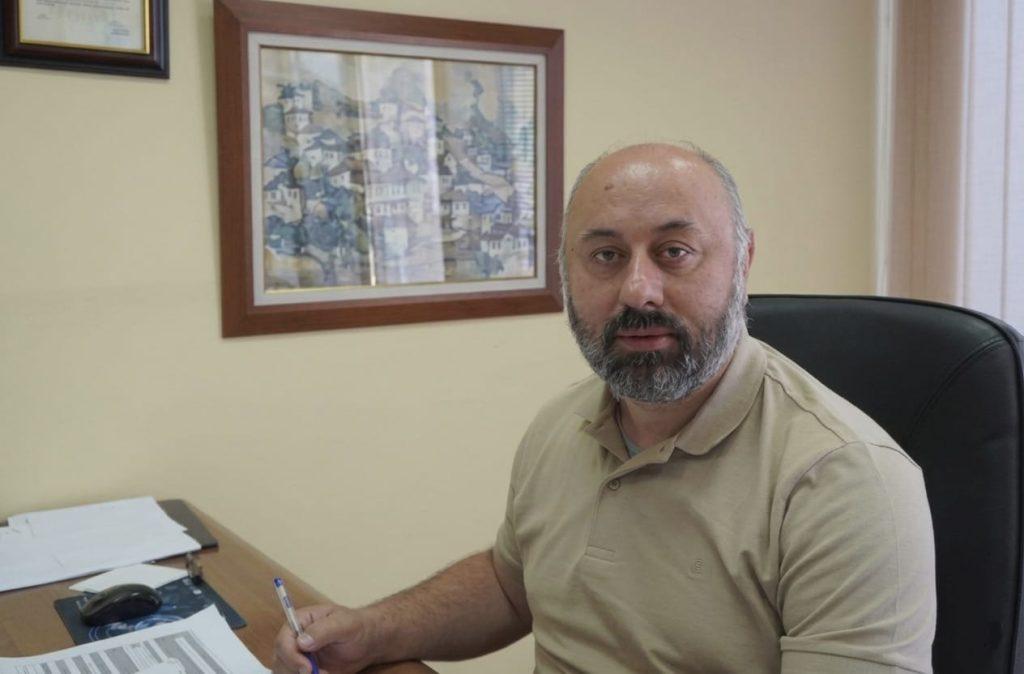
In the autumn of 2025, the government appointed historian and professional archivist Dimitar Bogeski, MA,as director of this institution. In an interview with BIRN, he assures that, following the implemented interventions, there are currently no problems with leakage.
However, like the previous government, he believes that the permanent solution for the archives is the construction of a new building that will meet the requirements for the operation of a modern archival institution. He announced that the initial project proposal, which will be presented to the government, is expected next year.
BIRN: Since the Archives moved into the new building in 2013, there have been problems with water leakage, which also endangered the depot where important documents are stored. What is the situation now?
Bogeski:The situation has now improved. We have undertaken certain activities to address the water leakage. About 90 percent of the drainage channels have been cleaned, and the remaining 10 percent still need to be fixed.
Once we finish cleaning them, we will see whether additional interventions are needed, and if necessary, we will carry them out. After the most recent rainfall, there were no leaks.
Another problem in the building was condensation, which creates conditions for the development of fungal damage on paper, potentially destroying documents. This issue is being addressed by repairing the chillers (cooling units). Around 70 percent have been repaired, and we are still waiting for parts in order to complete the repairs of all of them.
BIRN: Since 2019 there has been a government decision to build a new building for the Archives because this one is unsuitable. What is your opinion on a permanent solution to the problem, and can the construction of a new building be expected?
Bogeski:Of course, the future of archival activity in Macedonia lies in building a new facility. Personally, I have not entered into negotiations with the government regarding this project. I want us first to develop a project and a vision, and then present them to the government.
The project will be developed by experts from the Archives, together with architects. I believe that if we prepare it well, the government will have no arguments not to accept a solution that will secure the future of the Archives for the next 100 years.
We plan to start implementing this idea in 2027.
We would take Slovenia as a model for what the building should look like, as they put their new Archives facility into use almost a year ago. The Slovenian Archives are an example for us because, territorially, the size of the country is similar to ours, and also because of the way they work, since we were once part of the same state and operated under the same standards.
And even today, the standards are identical. The number of institutions that produce archival material is also similar, around four to five thousand, and the population size is comparable as well.
BIRN: Are there citizens who are interested and come to the Archives?
Bogeski:Unfortunately, very few. Citizens come mainly for personal needs, property-related matters, legal disputes, and similar cases. However, there are not many who come for scientific research purposes—only a few from the Institute of National History and from the History Department at the Faculty of Philosophy, meaning people who work in the field of historical science.
There is also limited interest from abroad—only a few researchers from Serbia and Turkey.
In the State Archives, 99 percent of the material we hold is available to the public.
Citizens who want to view something that is not necessarily for research purposes can also come. An ordinary citizen, researcher, or someone interested in a particular field can freely visit the Archives during working hours, submit a request for research, specify which collection they want to examine, and they can scan, photograph, or record the material.
Within two to three hours, the requested material is delivered, and the person can freely come to the library, i.e. the reading room, and research the material they are interested in.
With a donation from Slovenia, a software solution is currently being developed as a pilot project, which is expected to be completed in the autumn, and I expect it to be one of the most modern in Europe. All digitized collections and documents will be published, i.e. uploaded to that information system, and citizens, using their payment card and based on an official price list, will have access to all digitized documents.
This will remove the obligation for them to physically come to the Archives, and it will also make it easier for citizens in the diaspora to conduct research.
Автор: Фросина Димеска