
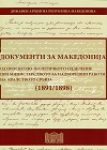
At the end of 2018, the State Archive of the Republic of Macedonia published the collection "Documents for Macedonia from the educational and political department at the Ministry of Foreign Affairs of the Kingdom of Serbia (1891-1898)" edited by prof. Dr. Silvana Sidorovska-Cupovska.
For the first time in this collection before the scientific public will be presented documents related to the problem of ownership of the church "St. Nikola ”in Kumanovo. Clashes between exarchs and patriarchs in the city escalated in early 1898, when both the Gate and the Sultan intervened to reconcile them. In addition to the consular representative in Skopje, the Serbian government also hired Stojan Novakovic, the acting royal envoy in Constantinople.
The documents published in the collection cover the periods from 1891 to 1893 and from 1897 to 1898. Most of the selected documents for the period 1891 to 1893 include reports and letters related to the work of the Serbian educational propaganda, and the attempts for its successful installation through the implementation of the guidelines received from the Ministry of Foreign Affairs. This was most often done through the teaching staff and attracting students from Macedonia to study in educational institutions in the Kingdom of Serbia. Until 1891, Serbian propaganda in Macedonia was funded by the treasury of the Society "St. Sava", the Ministry of Education and the Ministry of Foreign Affairs. The activity of the main board of the Association in Belgrade was in coordination with the opening of schools in Macedonia with the opening of the two schools, the Svetosava Evening School and the Svetosava Preparatory School. The first school had the task of spreading literacy among boys and adults from Macedonia and Old Serbia, and the second to train teachers. Students with successfully completed Svetosava evening school entered the second school.
The documents also follow the work of the Serbian consulate in Bitola through the activities of Consul Dimitar Bodi in the opening of Serbian schools in the Bitola Province. The activity of the Greek propaganda in the province was monitored through reports and letters sent by the secretary of the consulate, Branislav Nusic. The obstacles encountered by consular officials in the opening of Serbian schools were often reported to the royal mission in Constantinople. Similar reports were sent by the Serbian consulate in Skopje with requests for greater funding for more successful operations in areas outside the consulate, such as the town of Veles and its environs.
The translated documents for the period 1897-1898 mostly contain reports and letters sent by the consular representatives in Skopje, Bitola, Thessaloniki and Constantinople. Emphasizing education, Serbian propaganda was particularly active on the territory of the Kosovo Province, as evidenced by reports sent by the then consul in Skopje, Mihajlo Ristic. There was great interest for the city of Veles and for the larger villages in the Veles Casa, which according to the then administrative division were part of the Thessaloniki Province. Due to obstructions from the then Greek Metropolitan Antim, letters were sent almost daily from the Ministry of Foreign Affairs of the Kingdom of Serbia requesting monitoring of his activity.
Throughout the 19th century, Macedonia, with more or less intensity, attracted the attention of Serbian political circles. The increased interest became especially relevant after the end of the Eastern Crisis, when preparations for the continuation of the educational propaganda activity in Macedonia started again. The Serbian propaganda had obstacles in acting on the educational-propaganda plan from the Greek and Bulgarian propaganda, which confirmed their legality before the Ottoman authorities through their recognized churches, the Bulgarian Exarchate and the Patriarchate of Constantinople.
Serbian propaganda in the realization of its aspirations has always sought new ways and means of propaganda in Macedonia. However, without a church organization that could operate freely within the borders of the Ottoman Empire, it had only two alternative paths for its legal activity: work under the auspices of the Constantinople Patriarchate, which at the time was increasingly repressed by the Bulgarian Exarchate, and the second legal alternative. acting in Macedonia, with the direct approval of the Porte and the local Ottoman authorities. In order for her steps to be more successful at the Patriarchate of Constantinople and at the Gate, the Serbian government had to have the support of some great power. Given the policy of the great powers towards the Ottoman Empire and their influence in Constantinople, Serbia could only seek the aforementioned support from Russia, of course, in the constellation of mutual political relations, which Serbian diplomacy has successfully used. In seeking support from some Western European countries, it was clear to the political circles in the Kingdom of Serbia that it depended on the ongoing political situation in Europe, the Balkans and the Ottoman Empire, as well as on other political factors. In the period 1885-1898, Macedonia increasingly attracted the attention of statesmen, politicians and the public in Serbia.
In the selection of documents, we hope that those related to the success and discipline of students from Macedonia who were educated in educational institutions in Belgrade, Sabac and Valjevo will be of interest. A total of 159 documents have been translated in the collection and the original is in manuscript.
The documents published for the first time in this collection will be of interest to the scientific community and, of course, to the general public.
